
Wondering how to get edu backlinks that actually move rankings? .edu backlinks are links pointing to your website from domains owned by accredited educational institutions, such as universities and colleges. They are valuable because .edu domains typically carry high domain authority, strong trust signals, and long link lifespans. You can earn them through broken link building, linkable assets, faculty interviews, alumni pages, AI-powered link building platforms and student media sponsorships.
Quick Answer: The 7 proven ways to get .edu backlinks are:
- Reverse engineer competitor .edu links and pitch the same institutions
- Fix broken links on university resource pages
- Create career guides, templates and free tools students need
- Interview faculty members or quote them in your content
- Get featured on university alumni pages
- Use an AI-powered link building platform like Anchor Textor
- Sponsor student media such as university newspapers and podcasts
This guide covers all 7 methods in detail, including the exact steps, realistic costs and the mistakes that waste budget.
What Are .edu Backlinks?
.edu backlinks are inbound links from websites registered under the .edu top-level domain, which is restricted to accredited post-secondary institutions, primarily in the United States. Many site owners first ask how to obtain edu domain registration for themselves, but ordinary businesses cannot register one, which is exactly why links from these domains act as difficult-to-replicate trust signals.
Typical sources of .edu links include:
- University resource and careers pages
- Scholarship and financial aid listings
- Faculty and departmental blogs
- Alumni spotlight and directory pages
- Library and research guides
- Student newspapers, radio stations and podcasts
Are .edu Backlinks Still Worth It in 2026?
Yes, .edu backlinks remain worth pursuing in 2026, provided the linking page is topically relevant to your site. Educational domains tend to be old, heavily referenced and rarely deindexed, so the links they pass are stable and trusted. However, an irrelevant .edu link from a random directory page will do less for your rankings than a contextual link from a strong, relevant commercial site.
The practical rule: treat .edu links as one component of a natural link profile, not as a shortcut. Prioritise relevance first, authority second and the TLD last. Once you understand how to get edu backlinks the right way, the extension becomes a bonus on top of relevance, not a substitute for it.
7 Proven Ways to Get .edu Backlinks
The methods below run from pure outreach plays that cost nothing but time to budget-based routes that scale faster. Pick based on your resources, then combine two or three for the best results.
1. Reverse Engineer Your Competitors’ .edu Links
The fastest way to find edu backlinks opportunities is to identify institutions that already link to your competitors and pitch them a stronger alternative.
Steps:
- Enter a competitor’s domain into Semrush Site Explorer (or Ahref or Majestic).
- Open the Backlinks report and filter referring domains by “.edu”.
- Export the list and use AI to categorise which pages earn links: careers pages, free tools, statistics, templates or guides.
- Build or improve a matching asset on your site.
- Reach out to the page editor with a short, specific pitch explaining why your resource fits.
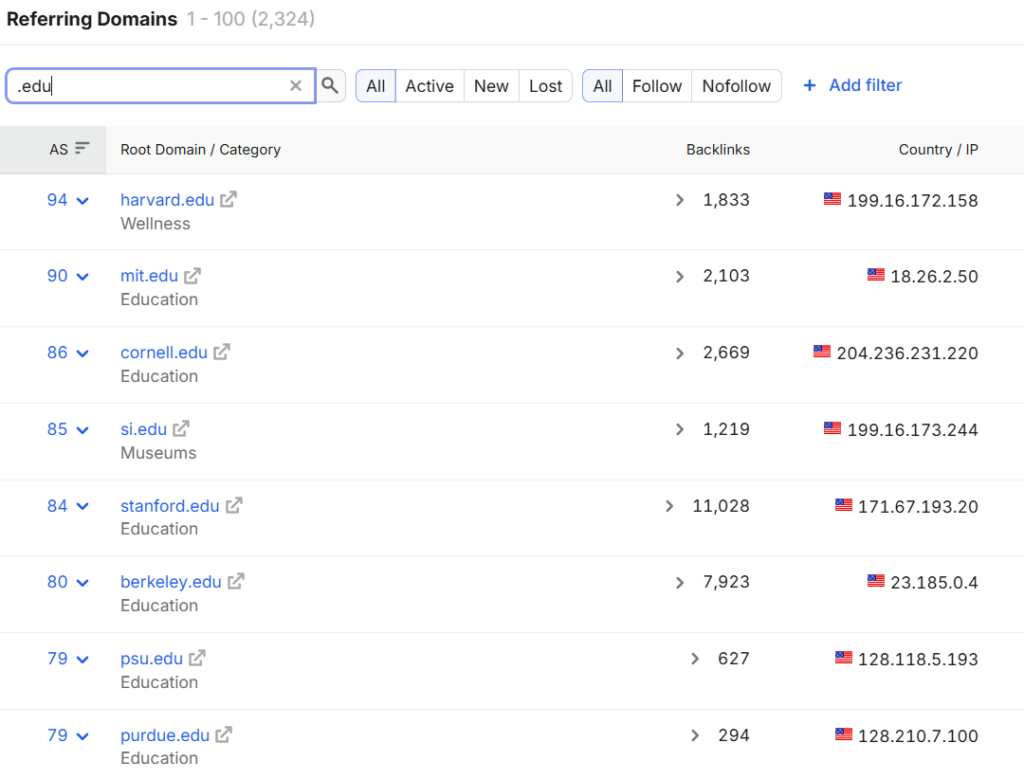
This analysis also reveals patterns. Universities consistently link to career resources, free tools, research data, templates and student-focused guides, which tells you exactly what to build next.
2. Use Broken Link Building on University Sites
Broken link building means finding dead outbound links on .edu pages and offering your own live page as a replacement. University sites are ideal targets because they are large, old and full of outdated resource lists.
Steps:
- Use Ahrefs’ Broken Links report or a crawler like Screaming Frog on university resource pages in your niche.
- Match each dead link to an existing page on your site, or create a close replacement.
- Email the webmaster or department, point out the broken link and suggest your page as the fix.
This works because you are helping the university maintain its site, not asking for a favour. Response rates are noticeably higher than cold pitches.
3. Create Educational Resources Universities Want to Link To
Universities link generously to assets that help their students learn skills, find jobs or manage life during and after study. Career-focused content is the single most linkable category.
High-performing asset types include:
- Career guides and interview preparation resources
- Free templates (CVs, business plans, budgets)
- Statistics pages and original research reports
- Glossaries and definition hubs
- Free interactive tools and calculators
- Startup and entrepreneurship resources
Local angle: this also works with schools and colleges near you. A locally relevant career asset pitched to nearby institutions faces far less competition than pitching a major university.
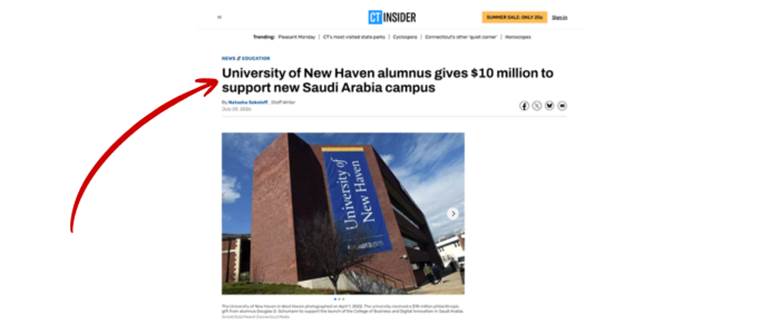
For example, the University of New Haven’s announcement of a $10 million alumni gift for its Saudi Arabia campus was picked up by the media. Stories like these often earn natural backlinks from news and industry websites.
4. Interview or Quote Faculty Members
Interviewing academics in your niche creates content they are motivated to share and link to from faculty profiles, departmental news pages, and personal pages hosted on the university domain.
Two ways to run it:
- Full interview: invite a professor onto your blog, podcast or YouTube channel, publish the piece, then ask them to reference it from their faculty page.
- Expert quote: if you cannot secure an interview, quote published statements from faculty in your articles with clear attribution, then notify them. Many will share or link to well-attributed coverage.
This method compounds. Once one academic features on your site, others in the same department become far easier to reach.
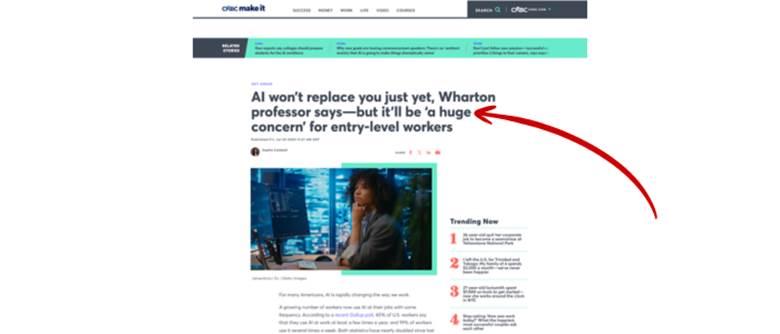
For example, CNBC featured insights from Wharton professor Ethan Mollick in an article on AI and the future of work. Expert interviews and faculty quotes add credibility to content and often encourage academic sharing and backlinks.
5. Get Featured on Alumni Pages
Most universities run alumni spotlight programmes that showcase what graduates are doing professionally, and these features almost always link to the graduate’s company. That makes them one of the most reliable .edu links available at zero cost.
Steps:
- List where you, your team or your client’s employees studied.
- Check whether those institutions run alumni spotlights, directories or “where are they now” features.
- Submit a short success story tied to the company you want linked.
The institution gets a good news story, the graduate gets recognition and the business gets a dofollow link from an authoritative domain, usually for the cost of one email.
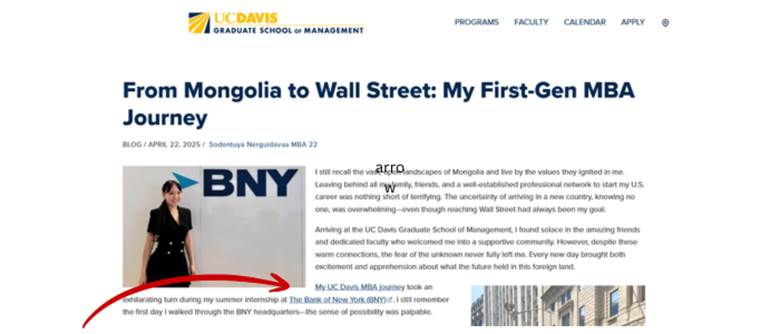
For example, UC Davis highlighted alumna Sodontuya Nerguidavaa’s journey from MBA student to a career at BNY. Alumni spotlight pages often feature graduates’ employers and link to their company websites, making them a valuable source of .edu backlinks.
6. Use an AI-Powered Link Building Platform: Anchor Textor
If manual university outreach is too slow for your timelines, Anchor Textor is an AI-powered link building platform that removes the guesswork. Instead of cold-emailing hundreds of institutions and hoping for replies, the platform’s AI matches your site with relevant, high-authority publishers and manages placements end to end.
Why it belongs in an .edu strategy:
- AI-driven relevance matching: the platform analyses your niche and target pages, then surfaces the publishers and link opportunities most likely to move rankings, the same relevance-first principle that makes good .edu links work.
- Anchor and placement control: you choose anchor text and destination pages, something you almost never control on university placements.
- Speed: placements go live in days, not the weeks or months typical of academic outreach cycles.
- Vetted quality: every site is screened for authority and traffic, so you avoid the spam traps that plague cheap “.edu links for sale” listings.
- Budget efficiency: transparent per-link pricing lets you compare directly against sponsorship costs and put budget where the strongest relevant links are.
The best-performing profiles combine a few trust-heavy .edu links with a steady flow of relevant contextual links, and this is exactly the mix an AI-powered platform makes manageable. Anyone serious about how to get edu backlinks at scale should pair manual academic outreach with a platform handling the contextual side.
7. Sponsor Student Media: University Newspapers, Radio and Podcasts
Student-run newspapers, radio stations and podcasts sit on .edu subdomains and openly accept sponsorships, yet almost no SEOs target them. Sponsor pages, episode notes and digital editions regularly link out to supporting businesses.
How to do it:
- Search for student newspapers, campus radio stations and student-run podcasts at universities relevant to your niche.
- Check their advertising or “support us” pages, most publish rate cards openly.
- Sponsor an issue, a show segment or a semester of coverage, typically 200 to 500 dollars.
- Request a linked sponsor credit on the .edu-hosted page as part of the agreement.
Because budgets are small and student teams are responsive, this is one of the cheapest and least competitive paid routes to a legitimate .edu link. Bonus: campus media coverage often gets picked up by the university’s main communications pages, which can earn a second link organically.
.edu vs .gov Backlinks: Which Are Better?
Neither .edu nor .gov backlinks are inherently better. .gov domains often carry higher average authority, while .edu domains are usually more topically relevant and more accessible for commercial niches.
| Factor | .edu backlinks | .gov backlinks |
| Typical authority | High (often DR 60 to 90) | Very high, often higher on average |
| Accessibility | Moderate, many legitimate routes | Difficult, few commercial pathways |
| Best fit niches | Careers, education, SaaS, marketing, ecommerce | Law, healthcare, cybersecurity, regulated industries |
| Common link sources | Resource pages, alumni pages, student media, tools | Official resources, compliance references, public data |
| Link longevity | Very long | Very long |
Practical guidance: if your niche overlaps with regulation, pursue .gov. For most businesses, .edu links are easier to land and more relevant.
Can You Buy .edu Backlinks Safely?
You cannot safely buy .edu backlinks as direct link placements, but you can pay for legitimate value exchanges that result in links, such as student media sponsorships, or use a vetted AI-powered platform for the contextual links around them.
Marketplace listings offering .edu links for 20 dollars are almost always spam placements on hacked pages, forum profiles or comment sections, and they carry penalty risk with no ranking benefit.
Avoid entirely:
- Fiverr and similar marketplace .edu link packages
- Automated backlink generators
- Comment, forum and profile links on .edu subdomains
- Mass scholarship pages with no real award behind them
Common Mistakes That Waste .edu Link Building Budgets
The most expensive mistake is chasing the .edu extension over relevance. An irrelevant DR 40 .edu link costs more time and money than a relevant, contextual DR 70 link from a commercial site, and it moves rankings less.
Other frequent mistakes:
- Sending generic “please link to my site” emails, which universities ignore
- Pitching thin content that gives the institution no reason to link
- Building only .edu links, which creates an unnatural profile pattern
- Ignoring nofollow considerations without checking how the page actually links out
- Falling for cheap “.edu links for sale” offers that turn out to be spam
Frequently Asked Questions
What is a .edu backlink?
A .edu backlink is a link to your website from a domain registered under the .edu top-level domain, which is restricted to accredited educational institutions. Because businesses cannot register .edu domains, these links act as difficult-to-replicate trust signals in Google’s evaluation of your site.
How do I get edu backlinks for my website?
The proven answer to how to get edu backlinks is combining outreach and budget-based methods: broken link building on university pages, career-focused linkable assets, faculty interviews, alumni features, AI-powered platforms like Anchor Textor and student media sponsorships. Start with competitor analysis to see which institutions already link in your niche.
How can I find edu backlinks my competitors have?
To find edu backlinks pointing at competitors, enter their domain into Ahrefs, Semrush or Majestic, open the backlinks report and filter referring domains by “.edu”. Export the results, identify which page types earn links and pitch those same institutions a stronger resource.
Can I get an edu domain for my business?
No. If you are researching how to obtain edu domain registration, be aware that .edu is restricted to accredited post-secondary institutions through EDUCAUSE. Businesses cannot register one, which is precisely why backlinks from existing .edu sites carry so much trust and are worth earning.
How much do .edu backlinks cost?
Legitimate routes range widely. Student media sponsorships start around 200 to 500 dollars, while outreach methods like broken link building and alumni features cost only time. AI-powered platforms price per placement transparently. Cheap marketplace .edu links priced at 20 to 100 dollars are almost always spam and should be avoided.
Are .edu backlinks dofollow or nofollow?
Both exist. Resource pages, alumni spotlights and student media sponsor credits are frequently dofollow, while some university systems apply nofollow site-wide. Check each target page’s existing outbound links before investing time, though even nofollow .edu mentions can drive referral traffic and brand trust.
How many .edu backlinks do I need?
There is no fixed number. A handful of relevant .edu links, typically 3 to 10, is enough to strengthen most link profiles when combined with contextual links from relevant commercial sites. Chasing volume for its own sake produces an unnatural profile and diminishing returns.
Are .edu backlinks better than regular backlinks?
.edu backlinks are generally more trusted than average links because of domain restrictions, age and authority, but a highly relevant link from a strong commercial site can outperform an irrelevant .edu link. Relevance and placement decide the outcome more than the TLD does.
What content do universities link to most?
Universities most frequently link to career guides, internship and job pages, free tools and calculators, templates, original statistics and research, glossaries and student resources. Anything that helps students find work or learn skills is the most reliable link magnet.